Mirror portal state
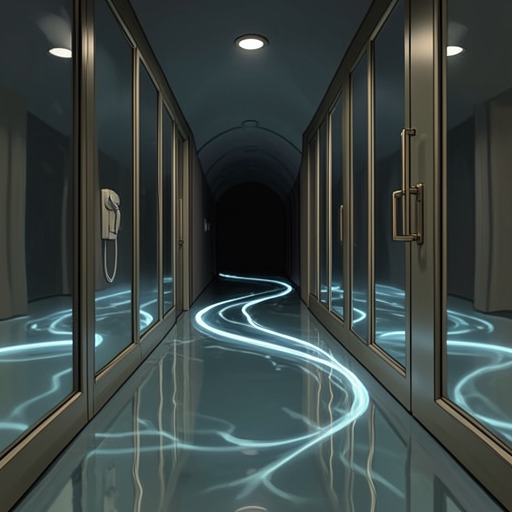
Living with 7 vampiresMirror portal state transforms the mirror from a passive household object into an active threshold between worlds. In this condition, its surface behaves like water rather than glass: a hand can enter it, a body can be pulled through it, and a traveler can emerge somewhere else. The state therefore carries both practical and existential danger, suspending Y/N and the vampires between ordinary space and the unknown realm beyond the reflection.
Definition and First Passage
The portal first appears as a mirror standing in darkness. A mysterious person leads Y/N toward it while Y/N remains unable to control her own body, then commands her to enter. Y/N reaches out, touches the surface with one finger, and finds that it feels like water. Her hand begins to pass into the mirror, establishing the portal’s defining physical rule: the reflective surface is permeable when activated, and passage begins through bodily contact rather than through a visible door or mechanical opening.
The mirror is also connected to coercion. Y/N does not choose the approach freely; her body is controlled as she follows the person. The portal thus marks not only movement between locations but the temporary suspension of agency. Entering the mirror means crossing a threshold while another force directs the traveler, making the passage inseparable from the danger of possession, hypnosis, or capture.
Seizure and Return
The portal’s threat becomes explicit when Jin’s body falls to the ground while a shadow remains standing and holds Y/N by the wrist. The shadow pulls Y/N inside the mirror, and the surface again feels like water. Y/N is consequently transported into the mirror rather than merely looking through it. The scene presents the portal as an instrument that an external entity can operate against a person: physical contact with the threshold becomes a means of abduction.
Passage is not guaranteed to lead to the expected destination. After Y/N gets through the mirror, she discovers that she is not where Jin is. Instead, she has returned to the normal world. The mirror remains present, but its glow has stopped and it has become an ordinary mirror again. This reversal makes the portal’s operation temporary and selective. Its visible transformation can end even when the traveler’s objective has not been achieved, leaving Y/N separated from Jin and without an active route back to him.
Attempts to Operate the Mirror
The portal state invites experimentation because the characters cannot treat the mirror as reliably understood. Jungkook tries to activate it by splashing water from a bucket over its surface, but the attempt fails and draws Jimin’s angry objection. The experiment is significant because it tests the portal’s water-like behavior through ordinary water; the resemblance between the mirror’s surface and liquid does not mean that water outside the portal can reproduce its power.
A more successful interaction follows when V walks to the mirror and places his hand inside it. His hand passes through the surface, confirming that the portal remains physically penetrable even though its activation and destination are uncertain. Y/N recognizes the phenomenon, suggesting that the group has begun to develop a shared understanding of the mirror’s abnormal function. Yet the scene does not establish complete control: the ability to insert a hand does not guarantee safe passage, a chosen destination, or the recovery of Jin.
Threshold, Agency, and Narrative Function
Mirror portal state repeatedly converts familiar surroundings into spaces of transition. The mirror’s shift from normal glass to glowing, water-like passage exposes the material object as something more than an image-producing surface. Its significance lies in the contrast between appearance and operation: when inactive, it is ordinary and reflective; when open, it becomes a route through which bodies and shadows can cross the boundary between worlds.
The state also organizes changes in identity and belonging. Y/N’s abandonment begins with an abrupt forced separation when her mother drives away after leaving her outside, and later crossings repeat that pattern in supernatural form: Y/N is moved away from safety, loses control over her location, and must navigate a threshold whose rules are controlled by others. In another transition, Y/N is nearly able to run but is seized from behind by Jackson, while elsewhere a red light suddenly falls upon her and frees her movement. These episodes reinforce a recurring structure in which motion is alternately blocked and granted by external powers.
The portal’s imagery reaches its most collective form when Y/N’s light and dark selves, together with a third aspect of Y/N, hold hands in a triangle and concentrate on returning to the normal self. Here, crossing is no longer only an individual act of abduction or escape; it becomes part of a deliberate configuration of divided identities. The mirror passage therefore supports the story’s broader concern with fragmented selves, unstable bodies, and the possibility that a threshold can be crossed only through an altered relation to the self.
Consequences and Significance
Every activation of the mirror changes the characters’ available choices. Y/N’s first contact initiates movement into supernatural danger; the shadow’s intervention turns the threshold into a trap; the later return to the normal world restores ordinary appearances but not the missing person. The group’s attempts to test the mirror reveal that its material behavior can be observed without being mastered, while Jin’s continued absence keeps the portal tied to an unresolved rescue objective.
The state is consequently both a passage and a failure of stable passage. It promises connection between separated people and worlds, but it can redirect travelers, erase the expected destination, or close before the desired rescue is complete. Its recurring water imagery makes the boundary seem soft and traversable, while the sudden changes in glow, agency, and location make that softness dangerous. Mirror portal state is the story’s clearest mechanism for turning reflection into rupture: what appears to be a surface becomes a threshold, and what appears to be a route becomes an ordeal.